
Throughout 2023, American educators have faced a rising tide of organized thought police whose aim is to remove texts from libraries that question or challenge their worldview. Their challenges to these texts often falsely label those who read provide access to the texts as pedophiles and deviants who are harming society. The texts that are targeted often feature characters from marginalized communities, are people of color, and/or are part of the LGBTQ+ community or these texts force the reader to tackle difficult issues like coming of age, mental health, and exploitation. My goal is to provide information and resources about challenged texts so that you, the reader, can make informed choices about what you read–because that is your RIGHT! In a society that relies on an educated citizenry for the survival of our way of life (a saying often erroneously attributed to Thomas Jefferson), literacy–READing–is a fundamental RIGHT. Reading for deeper meaning is essential to civic life. Jefferson did say that people could not “approve what they do not understand.” Banning books is promoting ignorance and a threat to intellectual freedom and healthy civic engagement. It keeps people away from understanding. Hence, banning books is a danger to civic life in a democratic America. So, my Project 2024 is to help provide that understanding and to be a fREADom RIGHTer fighting to help others access their rights to read freely and make up their own minds. I will review books that have featured frequently on book ban lists. Some of these texts are classics that are commonly taught in schools. Most of these texts are NOT taught in schools but are merely made accessible for students to make their own choices in reading material.
Lord of the Flies
by William Golding
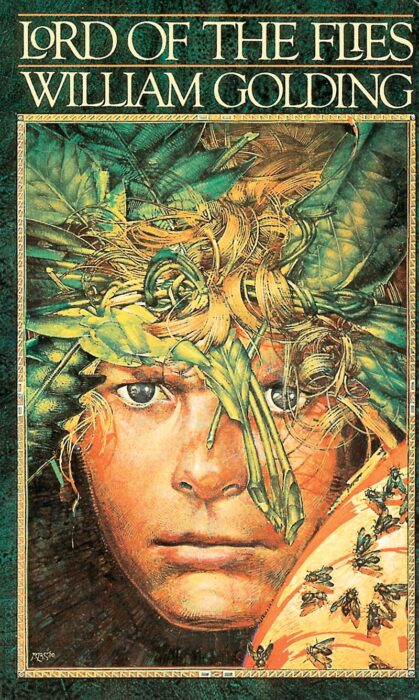
William Golding published The Lord of the Flies in 1954 exploring essential questions about the nature of man. Golding wrote this dystopian classic after his experiences in World War II. Ergo, the novel features boys at war with each other mirroring a world at war around them. The violence in the novel escalates from name-calling to murder. Watching little boys (the oldest is 13, the youngest is 4) failing as a society can be difficult, but the text prompts the reader to pick a side–agree that humans are inherently evil or disagree that they are driven to evil from lack of needs (Maslow’s hierarchy is an oft used companion with this text). Or maybe the reader can create a thesis of their own about the nature of humankind.
Golding’s writing richly weaves symbolism throughout–the novel is an allegory in which items and characters have symbolic and deeper meaning. Whether it’s Piggy’s glasses providing clarity, the conch demonstrating order, Simon as the ill-fated messenger, or the Lord of the Flies showing the evil within the hearts of humankind, the novel can prompt conversation that explores how these boys reflect the modern world around us too. The rich biblical allusions show the corruptive influence of evil–how a devil may retell a story of a Garden of Eden-type paradise that falls victim to the destructive nature of humankind. The novel is the name of a devil after all (Beelzebub translates to Lord of the Flies).
While I have read and re-read this novel many times in my years as an English teacher, it did take me a while to appreciate its multifaceted storytelling. This novel can be read through many critical lenses, like a colonialism lens (the portrayal of tribes as uncivilized), a gender lens (Piggy/sow as mother figures), a political lens (democracy versus authoritarianism), etc. I highly recommend that a first-time reader pick one lens to start their reading. There will be plenty in the text that the reader will connect with experientially–like being called names, losing when you feel you deserved to win, and wanting to escape the bonds of rules–but the novel will stretch those initial connections. For example, most of my students felt sorry for Piggy when Ralph called him “Piggy” despite his asking him not to do so. While this may seem like schoolyard games on the surface, my students explored the sense of shame that Piggy was made to feel for just being who he was. While Ralph is clearly the protagonist of the novel, the fact that he perpetrates this shame on Piggy in the opening pages of the novel shows how flawed and thoughtless he can be. These are important themes for readers to explore. I walked away from this novel always asking “How do we become better humans?” Golding seems to put forward a thesis that we do not become better humans. Most of my students disagreed with him on this premise. They tended to agree with Anne Frank–that people are essentially good at heart and that circumstances can often bring out the worst in human nature.
So, why is this book challenged so often? Well, violence is one reason. The allusion to biblical devils might be another. But the one act in the book that stands out is in the central chapter–chapter seven, “Shadows and Tall Trees.” Jack and his hunters surround and terrorize a sow that they have hunted. They commit unspeakably violent acts against this mother, including jamming a spear into her rear orifice. This passage in the text uses sexualized imagery, but honestly, it never says anything directly. Most of my students did not understand until they read the passage multiple times more closely. This passage potentially would need a trigger warning for people who have had trauma in their lives. But that doesn’t mean that the text is profane and shouldn’t be read. If anything, this passage begs the question of how these boys could ever think it okay to act in this way. It prompts questions about group think, about violence against the vulnerable around us. These are important questions for critical thinkers.
William Golding’s Lord of the Flies may have some uncomfortable moments, but it is a well-written novel that promotes critically engaging on the topic of human nature. I would recommend that novice readers use a study guide to interrogate the common thinking about the novel. Make no mistake though, I do recommend this book. How can we become our better selves if we never explore the darkness that lurks within?
You can purchase the book here.
Be a fREADom RIGHTer: join the fight against banning books! Here’s some resources to learn more:
Little Free Library fighting book bans.
Banned Books Week resources.
Unite Against Book Bans talking points.
American Library Association resources.

 Oh Yes Jules Did
Leave a comment